
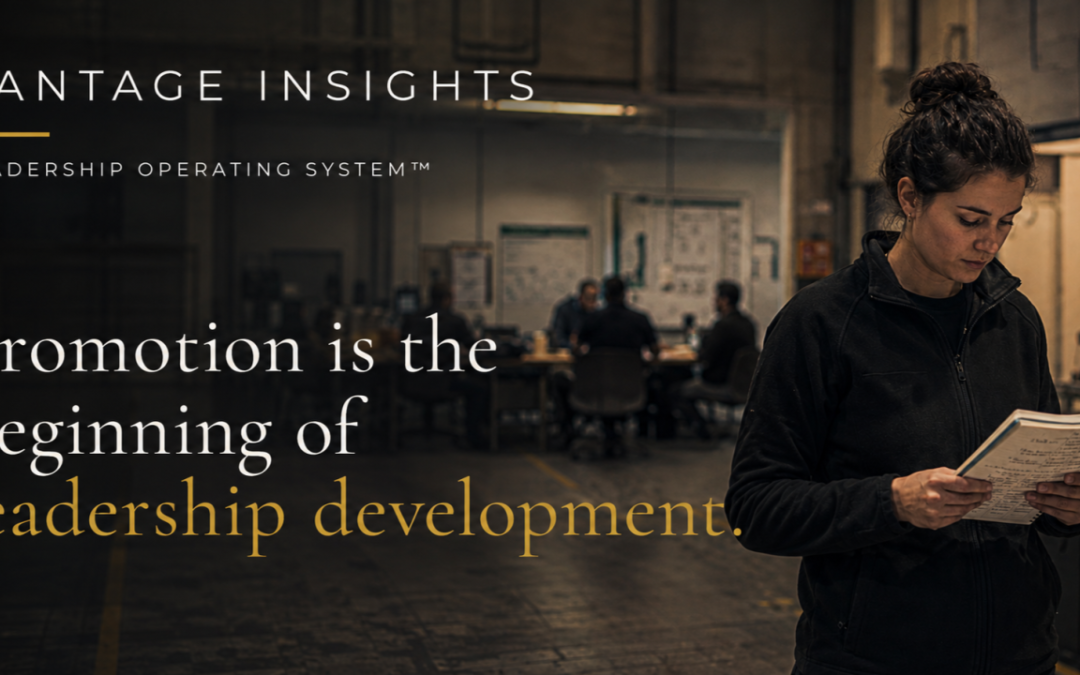
Promotion creates authority. It does not automatically create capability.
Organizations often promote people for very good reasons. They know the operation, solve difficult problems, earn trust and consistently deliver. But when they get promoted, the role changes. The new leader is expected to set direction, coach performance, navigate conflict, communicate decisions and create confidence for other people, often with little opportunity to practice those responsibilities before they become accountable for them.
When the transition feels difficult, the leader may interpret the discomfort as evidence that they are not ready. The radio station in their brain that tells them they are not ready, is amplified and their confidence takes a hit. Then, their leader may reach the same conclusion. Yet discomfort is not always a sign of poor fit. It is often the predictable result of doing important work that is unfamiliar.
The belief that strong leaders arrive into their role fully formed creates two problems. First, it places unrealistic pressure on new leaders to appear certain when they are still learning. Second, it allows the organization to treat leadership development as an individual responsibility rather than a capability the system should actively support.
Confidence is usually an outcome
Confidence is often discussed as though it must come first: feel confident, then lead. In practice, confidence is more likely to grow after a person has worked through a situation, received useful feedback and seen that they can handle it. Lived experience is what helps us grow. Recent research offers a practical view of how leadership confidence develops. In a 2025 study, participants completed progressively challenging group exercises that required them to rotate through real leadership responsibilities. Their leadership self-efficacy increased over time and was positively associated with how effectively they led. Although the study took place in a leadership-education setting, the implication for organizations is useful: confidence can grow through repeated, socially realistic leadership experiences. Telling a new leader to “be more confident” is less useful than giving them opportunities to prepare, lead, receive feedback, reflect and try again [1].
Additionally, research on deliberate practice shows that practice matters, but it is not the only contributor to performance [2]. The quality of the practice, the feedback available, the work environment and individual differences all influence development. Leadership capability grows when experience is structured well enough to create learning, rather than simply exposure.
The hidden cost of expecting instant readiness
When new leaders believe they must already know how to lead, they often hide the very questions that would help them improve. They postpone difficult conversations, over-prepare simple decisions or fall back on the technical work that made them successful before promotion. This is especially visible in operational environments. A new supervisor may step in to solve every problem personally because problem-solving feels familiar. A manager may avoid giving direct feedback because they have never seen the conversation handled well. A technically credible leader may provide detailed instructions and miss how to spin it to leadership. None of these patterns necessarily reflects a lack of leadership potential. They may reflect a lack of leadership practice.
Four ways to build readiness after promotion
1. Define the leadership work
Do not assume the new leader understands what success now requires. Identify the conversations, decisions and operating rhythms that matter most in the role. “Build trust” is too abstract. “Hold a weekly priority conversation, address missed commitments within two working days and conduct a monthly development conversation with each employee” creates something a leader can actually practice.
2. Prepare for real moments
Leadership practice does not need to be theatrical. Before a difficult conversation, ask the leader to explain the outcome they need, the questions they will ask and the point they may be tempted to avoid. Afterward, debrief what happened. This makes everyday work the place where development occurs.
3. Give feedback that improves the next attempt
“Good job” may encourage someone, but it does not tell them what to repeat. Useful feedback identifies the observable behaviour that helped or hindered the outcome. It might sound like: “You were clear about the standard, but the conversation ended without confirming who would do what by when.” The next attempt now has a focus.
4. Normalize learning without lowering standards
Supporting development does not mean excusing harmful behaviour or avoiding accountability. It means being clear about the standard while recognizing that capability is built through coached experience. A leader can be responsible for improving and supported while they do it.
Build a system that makes growth more likely
Organizations will always need individual judgment, courage and commitment from leaders. But they should not require every leader to invent the fundamentals alone.
A dependable leadership system gives people shared expectations, practical tools, opportunities to rehearse important conversations, feedback on observable behaviour and operating rhythms that reinforce the work. Over time, leaders build a body of experience they can draw upon under pressure.
Great leaders are not born ready. They become more ready through the work, especially when the organization is intentional about how that work becomes learning.
At Vantage Collectiv, we help organizations move leadership development closer to the moments where leadership is actually required. The goal is not to create identical leaders, but to make essential leadership practices more dependable across the organization.
Call to action: Where are your new leaders expected to perform before they have had a meaningful opportunity to practice?
- Torrico, B. H., et al. (2025). “Increasing Leadership Self-Efficacy Through Experiential Learning in Student Groups.” Journal of Management Education. View the research
- Macnamara, B. N., Hambrick, D. Z., & Oswald, F. L. (2014). Deliberate Practice and Performance in Music, Games, Sports, Education, and Professions: A Meta-Analysis. Psychological Science, 25(8), 1608-1618.