
Most leaders have experienced some version of this moment.
A deadline is missed. Work comes back differently than expected. A team member makes a decision that creates another problem. A standard everyone was supposed to understand is not followed.
The instinctive question is understandable: Why didn't they do what was expected?
Sometimes that is exactly the question that needs to be asked. But there is another question worth asking first: Was the expectation actually clear enough to act on?
That distinction matters because organizations can spend considerable effort trying to strengthen accountability when the problem began much earlier.
It began with clarity.
Reality
The accountability problem may have started upstream
Work moves quickly. A leader assigns something between meetings, or priority changes halfway through the week. An experienced employee is assumed to know what “good” looks like. A decision is made in a meeting, but ownership is never explicitly confirmed before the meeting ends. How many times has a meeting ended with good ideas, but there is no clarity on who is taking on which action?
Everyone leaves believing there is alignment, but then reality reveals otherwise.
This is one reason accountability can become frustrating for both leaders and employees. The leader remembers communicating the expectation. The employee remembers hearing something less specific. Neither necessarily acted irresponsibly, but lack of clarity remains.
The system allowed ambiguity to survive until the moment of performance.
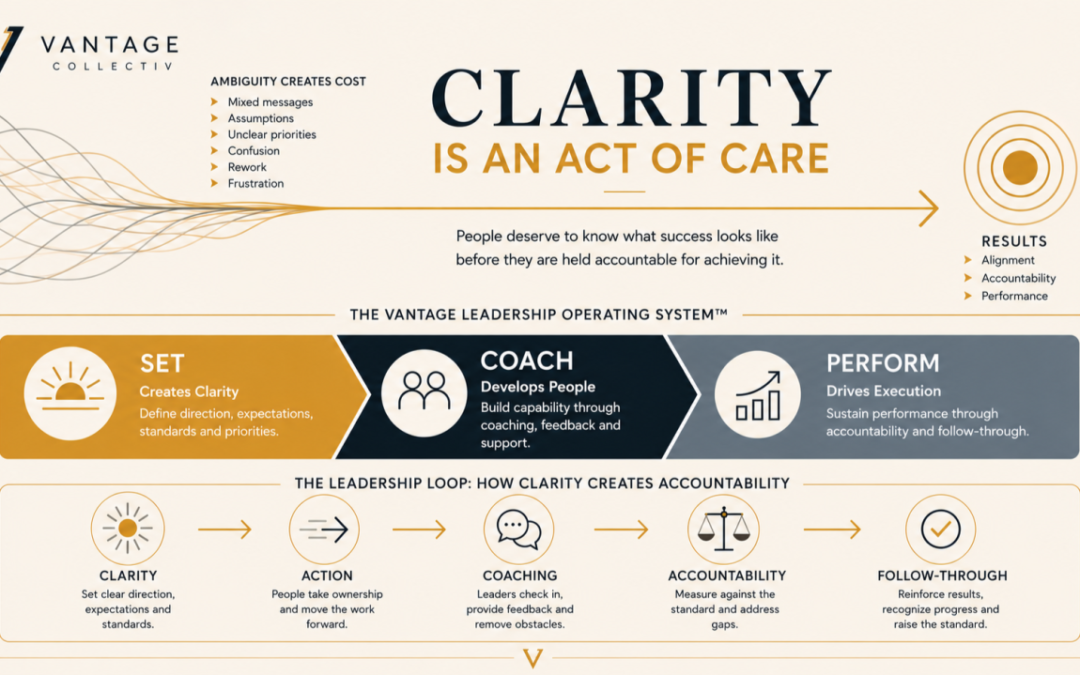
At Vantage Collectiv, we believe clarity is an act of care. People should understand what is expected, why it matters, what they own and how success will be recognized before they are expected to deliver against it.
That makes clarity more than a communication skill, but part of the infrastructure of accountability.
Insight
Communication is not the same as clarity.
One of the most persistent assumptions in organizations is that because something was said, it was understood. Those are different outcomes.
Research has been pointing to the importance of role clarity for decades. A meta-analysis published in the Journal of Management examined 74 independent correlations involving 11,698 people and found a negative relationship between role ambiguity and job performance. A 2026 meta-analytic review covering six decades of role-stressor research went further, finding role ambiguity to be the most damaging of the role stressors examined overall.
Gallup similarly treats knowing what is expected at work as a foundational employee need. Gallup’s extensive employee engagement research also identifies clear expectations as one of the fundamental conditions of an effective workplace. Gallup also emphasizes that effective managers go beyond simply telling people what to do: they discuss explicit and implicit expectations and help employees understand what strong performance looks like.
The practical implication is important. A leader can communicate frequently and still leave people unclear. The problem is rarely a lack of words. The problem is whether those words create a shared understanding of priorities, standards, ownership, decision rights and success.
System
Accountability begins with SET
Within the Leadership Operating System™, SET creates clarity.
That placement is intentional.
SET comes before COACH and PERFORM because meaningful coaching and fair accountability depend on people knowing what they are working toward in the first place. Vantage Collectiv's Leadership Operating System Assessment reflects this connection by examining direction and priorities, expectations, communication and alignment before moving into coaching and performance. Think of accountability as a loop rather than a conversation at the end of the work. A leader creates clarity about the outcome.
The employee acts. The leader checks progress and coaches where necessary.
Both sides adjust as conditions change. Performance is reviewed against an expectation that was understood from the beginning.
The loop closes.
When SET is weak, leaders often have to compensate later. They clarify after confusion appears, coach after a preventable mistake or address performance against standards that were never sufficiently established.
The organization experiences this as firefighting, and the leader experiences it as frustration. Additionally, the employee experiences it as unpredictability.
The Leadership Operating System™ Maturity Model identifies this pattern at lower levels of maturity: priorities change, roles and expectations lack clarity, follow-up is inconsistent and work becomes reactive. As the system matures, priorities, communication and accountability become increasingly predictable.
This reveals something important about operational leadership:
Accountability is not simply the courage to address poor performance. It is the discipline to create the conditions for good performance before the work begins.
Practice
Three ways to create clarity before accountability
1. Define the outcome, not just the activity
Before assigning important work, explain what successful completion looks like.
What needs to be true when this is finished? What standard matters? What is the priority? What constraints or decision boundaries exist?
“Please take care of this” transfers a task. Clarity transfers an outcome.
2. Confirm understanding instead of assuming it
Avoid turning this into a test by asking, “Do you understand?” Most people will say yes.
Instead, make alignment part of the work: ask how the person plans to approach it, what they see as the priority, where they expect difficulty or what decisions they believe they can make independently.
Their answer gives both people an opportunity to discover ambiguity while it is still inexpensive to correct.
3. Re-SET when the conditions change
Clarity has a shelf life. Priorities shift. Customers change requirements. Resources disappear. New information arrives.
When the conditions change, leaders need to revisit the expectation rather than continuing to hold people accountable to an outdated understanding.
Re-setting is not micromanagement. It is maintaining alignment as reality changes.
Reflection: Make accountability more predictable
Strong accountability should not feel like an organizational surprise. People should generally know what matters, what they own, where they have authority, how progress will be reviewed and what happens when commitments are not met.
That does not eliminate difficult conversations. Leadership still requires leaders to say what needs to be said, maintain standards and follow through.
But the conversation changes when clarity came first. Instead of debating what someone thought was expected, the leader and employee can focus on what happened, what was learned and what needs to happen next.
That is a more useful form of accountability. And it points to a broader principle behind the Leadership Operating System™:
Leadership becomes more dependable when organizations design the moments before the problem, not only improve the conversations that happen after it.
Reflection question: Before you hold someone accountable this week, ask yourself: did I give them enough clarity to succeed?