
REALITY | The cost of variation rarely shows up as a leadership problem
Most organizations would never accept a critical operating process that changed depending on who happened to be running the shift.
Safety standards do not become optional because a different supervisor starts at 7:00 p.m. Financial controls are not reinvented by every manager. Quality processes are designed specifically to reduce unnecessary variation.
Yet leadership often operates differently.
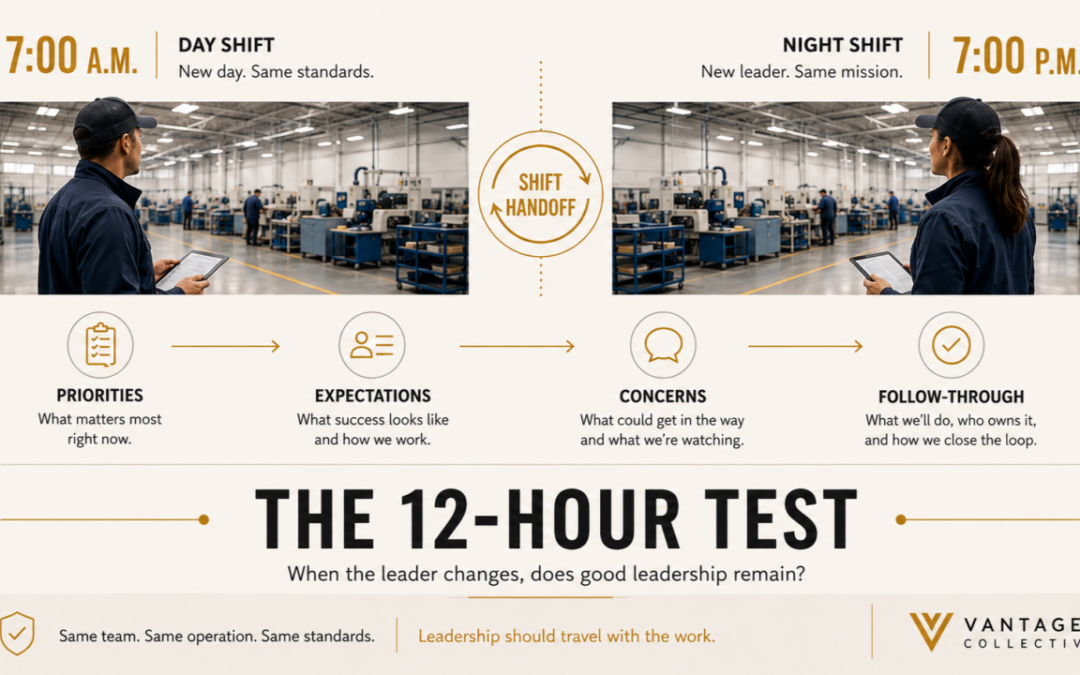
One supervisor starts the day by making the priorities, risks and expectations clear. Twelve hours later, another supervisor takes over and assumes everyone already knows.
Same operation. Same standards. Same organization. Different leadership.
It happens when a project leader knows a critical milestone is slipping but avoids the difficult conversation because the team is already under pressure. Months later, the multi-million-dollar project is over budget and everyone is trying to determine when the problem began.
It began earlier. When something important needed to be said and wasn't.
It happens when one manager addresses a missed commitment while another quietly takes the work back and finishes it themselves. Or, when three departments leave the same meeting with three different interpretations of the decision, or, when a performance issue appears in an annual review even though nobody clearly addressed it six months earlier. We give these problems different names. Communication. Execution. Accountability. Performance. Project management.
But underneath them can be the same organizational condition:
The quality of leadership depends too heavily on which leader happens to be in the moment.
And organizations pay for that variation through rework, escalation, delayed decisions, manager dependency, missed deadlines, unnecessary meetings and problems that become more expensive because they were not addressed when they were small.
Variation in leadership creates variation in how work gets done.
INSIGHT | Look upstream
When something goes wrong, we naturally focus on where the failure became visible. The project went over budget, the deadline was missed, the employee did not perform, the team failed to execute. But that is not necessarily where the problem began.
Go upstream. Was the expectation clear? Did everyone understand the same priority? Did somebody recognize the risk earlier? Did they raise it? Was the difficult conversation held while the issue was still small? Was ownership clear? Did anyone follow through?
Not every business problem is a leadership problem. But leadership influences how quickly organizations surface problems, create clarity, make decisions, develop capability and respond when performance begins moving off course.
Leadership often operates upstream of performance.
By the time a metric changes, the organization may already be seeing the accumulated effect of dozens of conversations, decisions, expectations and follow-ups that happened weeks or months earlier.
There is another reason this can be difficult to see. Often, good leaders can hide a weak leadership system, and every organization has these leaders.
The supervisor who runs a remarkably tight shift. The project leader who hears about problems early. The manager whose people always know what is expected. The leader everyone calls when something difficult needs to get back on track.
Then that leader gets promoted, transfers, retires or leaves. And suddenly the team that always ran well doesn't. Perhaps the replacement is less experienced.
But another possibility deserves consideration:
The organization never captured what the previous leader was doing that made the team work.
Their routines left with them. Their coaching practices left with them. Their way of creating clarity, addressing problems and following through left with them.
The organization had an excellent leader. It did not necessarily have an excellent leadership system.
SYSTEM | When leadership stops depending on the leader
Vantage Collectiv’s Leadership Operating System™ begins with a simple premise:
Leadership should not depend on luck, personality or circumstance. That does not mean creating identical leaders.
One employee may need coaching. Another may need greater clarity. Someone else may need a direct conversation about a commitment they have repeatedly missed.
Those conversations should be different. But the fundamentals should remain dependable. Expectations are clear. People are heard. Standards matter. Difficult issues are addressed. Commitments are followed through.
At Vantage Collectiv, those fundamentals connect through three disciplines:
SET creates clarity. COACH develops capability. PERFORM sustains execution.
The shift change where expectations disappear points to SET.
The supervisor who continually solves problems for employees instead of developing their thinking points to COACH.
The meeting where commitments are made but never revisited points to PERFORM.
The project drifting over budget may involve all three.
The purpose is not to label every problem with a framework.
It is to recognize that seemingly disconnected operational problems can share an upstream condition: the leadership practices surrounding the work are inconsistent.
A Leadership Operating System™ makes those practices more intentional, repeatable and easier to sustain...Not scripted leadership but dependable leadership.
PRACTICE | Three places to look tomorrow
1. Look at the handoffs.
Find where work moves between shifts, teams or leaders. Does clarity move with it? Or does every new leader recreate priorities, expectations and standards?
2. Find the conversation that isn't happening.
Most teams have one: a performance concern, project risk, unresolved behaviour or difficult decision.
Ask a simple question:
What could another 30 days of silence cost?
3. Follow one recurring problem upstream.
Choose something that keeps appearing: rework, escalation, missed deadlines, poor ownership or excessive meetings.
Trace it backwards.
Where was the first opportunity to create clarity? To coach? To raise the concern? To follow through?
You may discover that a recurring operational problem is being reproduced by a recurring leadership pattern.
REFLECTION | The 12-hour test
Perhaps the simplest way to assess a leadership system is at shift change.
One supervisor goes home. Another walks through the door. Do the expectations remain clear? Do the standards remain? Can people still raise concerns? Will difficult issues still be addressed? Will commitments still be followed through?
Does good leadership remain?
If the answer depends entirely on who walked through the door, leadership is still primarily an individual capability.
The opportunity is to make it an organizational one.
Reflection: Where in your organization does the quality of the work change because the quality of leadership changes with the person leading it?
Check out this read from McKinsey & Company Making the most of the matrix organization | McKinsey