
Reality
A supervisor is promoted because they're the best technician on the team. A manager earns a leadership role after consistently delivering results. A frontline leader accepts greater responsibility because someone recognized their potential.
They're given a title. Perhaps they're sent to a leadership course.
Maybe they're handed a competency framework or a stack of policies. Then they're expected to figure leadership out on their own.
Months later, one leader is thriving while another is struggling. One team is highly engaged while another experiences constant turnover. One department consistently executes while another seems trapped in a cycle of firefighting.
The conclusion is almost always the same. "We need better leaders.” Or “One of the leaders isn’t performing.” But what if that's the wrong diagnosis? What if the issue isn't the quality of the people we've promoted, but the quality of the system we've given them to lead within?
Insight
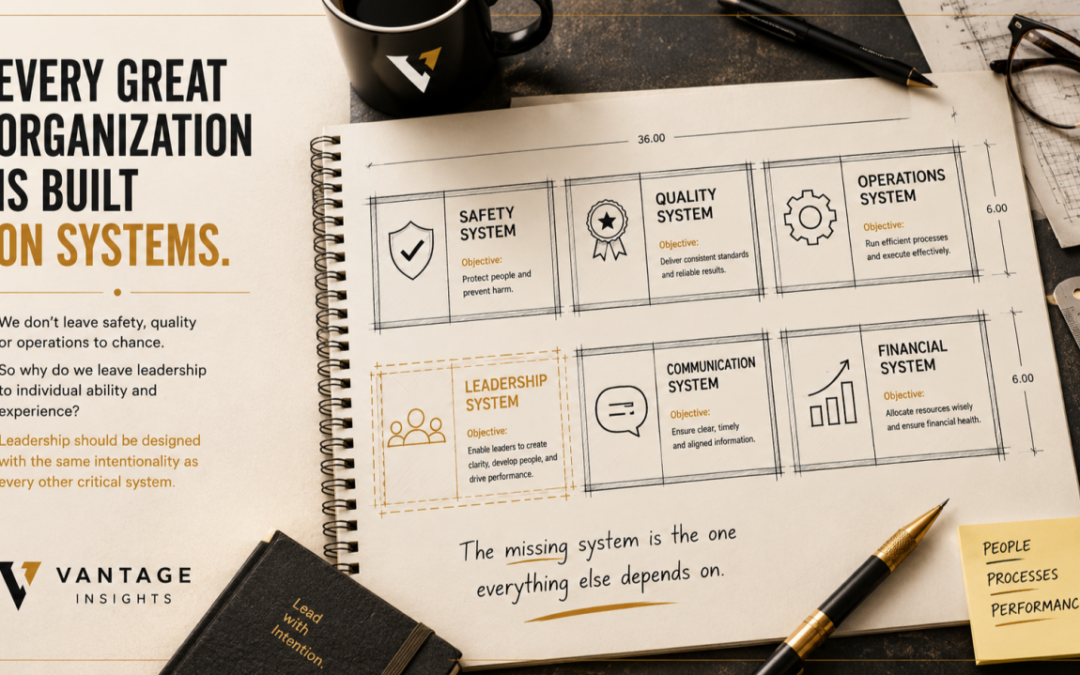
Organizations have become remarkably good at building systems. We have systems for safety, finance, quality assurance, operations, risk. These stems exist because we've learned something important over decades of organizational experience: consistency doesn't happen by accident. Every rule has a story. If a rule (or system) seems necessary, its likely because there was an incident that required it.
We don't expect people to remember every safety procedure under pressure. We build systems that make safe behaviour easier. A shared space with all policies. A board where safety expectations are pinned. Additionally, we don't leave financial reporting to individual interpretation. We create standards, governance, and repeatable processes. Even quality assurances have common expectations that create predictable results. Yet, leadership is mostly treated differently.
Instead of creating a shared operating system, we rely on individual personality, past experience, or natural ability.
One leader checks in with a team regularly. Another doesn’t check in at all. Another believes no news is good news. One provides frequent coaching. Another only speaks up when something goes wrong. One creates clarity before assigning work. Another assumes everyone already knows what's expected.
None of these leaders are necessarily trying to do a poor job. They're simply leading with whatever experience, habits, and instincts they have available.
The result isn't inconsistent leadership because people don't care. It's inconsistent leadership because the system itself is inconsistent, or non-existent.
When leadership depends on personality instead of practice, employees receive a different experience depending on who they report to. Some receive clear expectations, others receive assumptions. Some receive coaching. Others receive silence. Some experience accountability supported by empathy. Others experience accountability only after something has gone wrong.
Eventually those differences become visible across the organization. Execution varies. Trust varies. Engagement varies. Performance varies.
System
At Vantage Collectiv, we believe leadership should be designed with the same intentionality as every other critical business system. Leadership should never depend on luck, personality, or circumstance. It should be supported, defined, practiced, reinforced and measured.
Just as a safety management system creates a consistent approach to safety, a leadership operating system creates a consistent approach to leadership. It doesn't ask every leader to become the same person.
It creates common fundamentals that every employee deserves to experience, such as clear expectations, purposeful coaching, honest conversations, meaningful follow-through, support during uncertainty and accountability delivered with empathy.
When those behaviours become shared organizational practices instead of individual preferences, leadership becomes more dependable. That's the difference between developing individual leaders and developing organizational leadership capability.
One relies on exceptional people, while the other creates conditions where ordinary leaders can consistently do exceptional work. Leadership stops being something a few people are naturally good at. It becomes something the organization intentionally supports every day.
Practice
If you're wondering whether your organization has a leadership problem or a leadership systems problem, begin with three questions.
1. Look for patterns, not personalities.
When leadership quality varies significantly between teams, ask whether expectations are consistent. If every leader is inventing their own approach, variability is inevitable.
2. Examine the system supporting your leaders.
Do leaders share common expectations for creating clarity, coaching people, providing feedback, and following through? Or are they expected to "find their own style" without a common foundation?
3. Shift the conversation.
Instead of asking, "How do we build better leaders?" ask, "What kind of leadership system would help every leader succeed more consistently?"
That single question changes where improvement begins.
Reflection
Organizations rarely leave safety, finance, or quality to individual interpretation.
So why do we still leave leadership to chance?